Custom Software Development Cost in Saudi Arabia (2026 Guide)
10 min read
On this page
- The short answer
- Software development costs by project type
- What actually drives the price
- How a quote is calculated: a worked example
- Step 1: estimate the hours
- Step 2: price the same hours three ways
- Where the money goes, phase by phase
- Costs most budgets miss
- How to lower the cost without cutting corners
- Frequently asked questions
- How much does custom software development cost in Saudi Arabia?
- What factors affect software development costs?
- How long does it take to build custom software?
- What is the hourly rate for software developers in Saudi Arabia?
- How much does software maintenance cost each year?
- Is it cheaper to outsource software development or build an in-house team?
- Get a quote you can trust
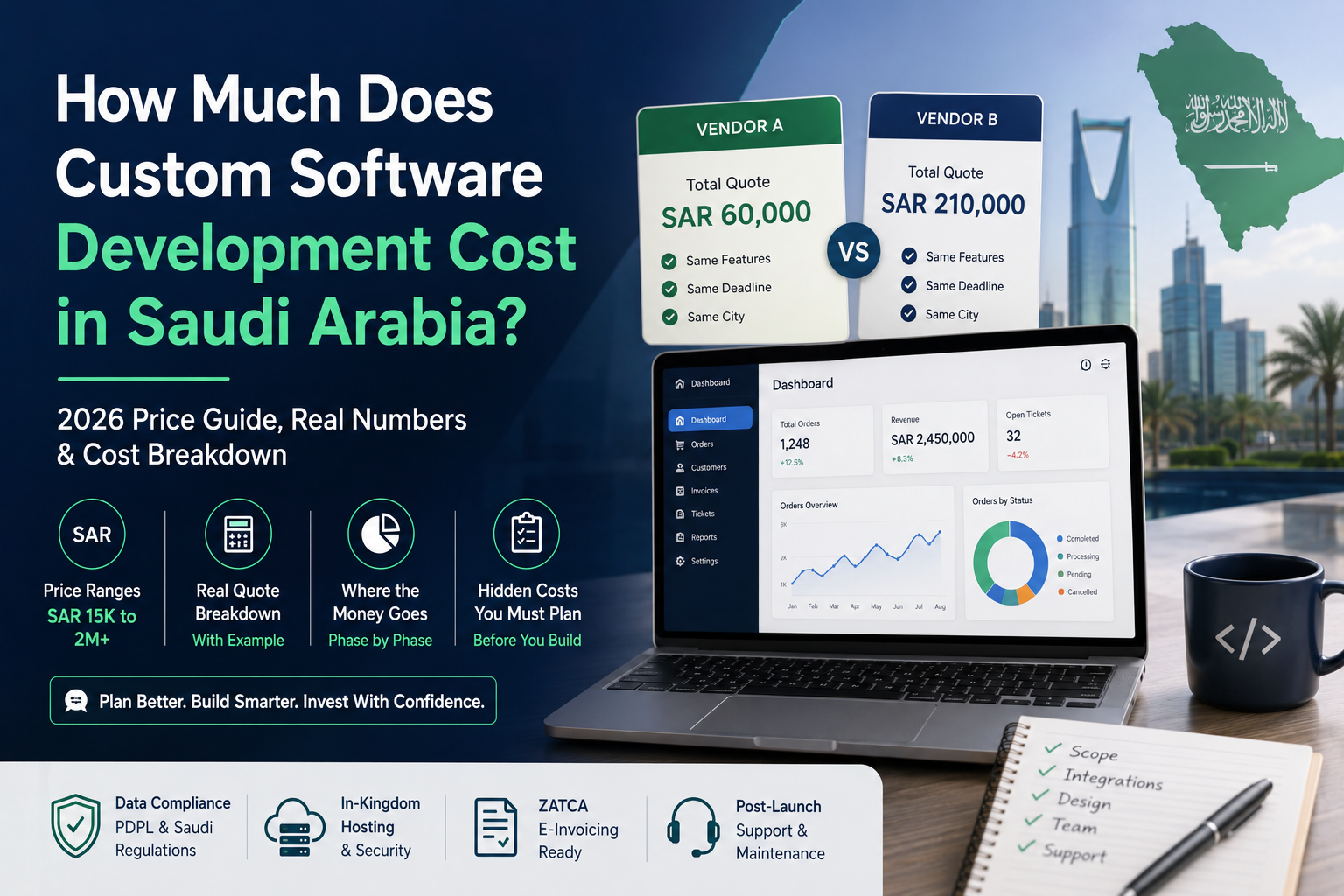
wo vendors quote for the same customer portal. One says SAR 60,000. The other says SAR 210,000. Same features, same deadline, same city.
Neither is necessarily lying. They're just pricing different teams, different assumptions and different amounts of work after launch. Once you know how a quote is built, the gap stops looking random.
This guide gives you the price ranges Saudi agencies publish, the maths behind a real quote, and the costs most budgets forget. If you're still deciding whether to build at all, start with custom vs off-the-shelf software [add link when live].
The short answer
Custom software development in Saudi Arabia typically costs SAR 30,000 to SAR 300,000 for most business apps and portals, while ERP, SaaS and enterprise systems run from about SAR 250,000 to well over SAR 1 million. Where you land depends on three things: how much you build, what it must connect to, and who builds it.
The rest of this guide shows how each of those three moves the number.
Software development costs by project type
Software development costs in Saudi Arabia scale with what the system has to do. A booking tool for one branch and an ERP for five warehouses are both "custom software", but they sit at opposite ends of the price range. Here's what agencies in the Kingdom publish for 2026.
|
Project type |
Typical scope |
Published range (SAR) |
Typical timeline |
|---|---|---|---|
|
Simple business tool |
Booking, forms, internal tracker, one user role |
15,000 to 100,000 |
2 to 4 months |
|
Customer portal or web app |
Logins, dashboards, orders or tickets, admin panel |
30,000 to 300,000 |
4 to 8 months |
|
Custom CRM |
Leads, pipeline, customer records, reports |
80,000 to 300,000 |
4 to 8 months |
|
Custom e-commerce platform |
Catalogue, payments, orders, customer accounts |
100,000 to 500,000+ |
4 to 8 months |
|
SaaS platform |
Multi-tenant, subscriptions, billing, analytics |
150,000 to 800,000+ |
4 to 8 months |
|
Custom ERP |
Finance, inventory, HR, procurement modules |
250,000 to 1,000,000+ |
6 to 12+ months |
|
Enterprise system |
Banking, healthcare, logistics at scale |
800,000 to 2,000,000+ |
6 to 12+ months |
Ranges compiled from 2026 price guides published by Saudi and regional software agencies. Timelines follow the same sources: small projects 2 to 4 months, medium 4 to 8, large 6 to 12 or more.
You'll notice the floors don't agree. Some Saudi agencies start simple projects around SAR 15,000; others won't go below SAR 30,000. That's mostly a difference in what each one calls "basic" and where its developers sit. If your project is an ERP, our guide to ERP implementation cost in Saudi Arabia [verify URL] goes deeper.
Want a number for your own scope instead of a range? Get a custom software quote built on a short discovery session.
What actually drives the price
Seven factors decide almost every custom software quote in Saudi Arabia. Scope and integrations set how much work there is; team location and seniority set what each hour of that work costs. The rest add or remove risk.
- Scope and features. Every screen, user role and report is work. A portal with three roles costs more than one with a single login.
- Integrations. Each connection to an ERP, payment gateway, SMS provider or government platform such as Nafath adds design, build and testing time. Integrations are where loose quotes most often blow up.
- Design depth. Adapting a clean template is cheaper than custom UX research, prototypes and a full design system. Arabic right-to-left layouts need their own design pass, not a mirrored English page.
- Team location and seniority. Published rates in Saudi Arabia run from about SAR 80 to SAR 600 per hour. Companies typically charge SAR 350 to SAR 600, senior individual developers SAR 300 to SAR 450, and mid-level developers SAR 180 to SAR 300.
- Compliance and hosting. Handling personal data under PDPL, security testing and in-Kingdom hosting all add hours, especially in finance, health and government work.
- Deadline. A rushed launch means more people working in parallel, and more coordination cost.
- What happens after launch. Some quotes include a warranty and a few months of support. Others stop at handover. Two quotes can look far apart simply because one includes a year of care.
How a quote is calculated: a worked example
A software quote is estimated hours multiplied by a blended hourly rate, plus anything bought from third parties. The hours come from the scope. The rate comes from who does the work. Change either one and the total moves, which is exactly why two honest quotes can differ by SAR 150,000.
Take a typical customer portal [add link when live] MVP for a Saudi B2B company: customer login, order tracking, invoice downloads, a support ticket form, an admin panel, and Arabic plus English.
Step 1: estimate the hours
|
Phase |
What happens |
Hours |
|---|---|---|
|
Discovery |
Workshops, scope document, feature list |
40 |
|
UI/UX design |
Wireframes, Arabic and English screens |
80 |
|
Front end |
Customer screens and admin panel |
160 |
|
Back end |
Database, APIs, logins, invoices |
220 |
|
QA and testing |
Functional, security and RTL checks |
80 |
|
Project management and launch |
Demos, deployment, handover |
60 |
|
Total |
640 |
Step 2: price the same hours three ways
|
Team type |
Blended rate (SAR/hour) |
Build cost |
With 15% VAT |
|---|---|---|---|
|
Local software company, senior team |
400 |
SAR 256,000 |
SAR 294,400 |
|
Hybrid: local PM, offshore developers |
200 |
SAR 128,000 |
SAR 147,200 |
|
Offshore-heavy or junior team |
90 |
SAR 57,600 |
SAR 66,240 |
Illustrative estimate. Rates are chosen from inside the published Saudi band of SAR 80 to SAR 600 per hour; your hours will differ with scope.
Same 640 hours, three very different totals. Now look at your real quotes: does each one tell you the hours, or only the total? A vendor who can't show you roughly how they got to their number is guessing, or hiding something.
Two more things change the hours themselves. Every extra integration adds its own back-end and testing hours on top of this list. And skipping discovery doesn't remove those 40 hours; it just moves them into change requests later, at a higher price.
Where the money goes, phase by phase
Most of a custom software budget goes into building the back end and front end, usually more than half combined. Discovery and design are small slices, but they decide whether the expensive slices get built once or twice.
|
Phase |
Typical share of the budget |
|---|---|
|
Discovery and business analysis |
5 to 10% |
|
UI/UX design |
10 to 15% |
|
Front-end development |
20 to 30% |
|
Back-end development |
30 to 40% |
|
QA and testing |
10 to 15% |
|
Deployment and launch |
5 to 10% |
Shares as published in a 2026 Saudi cost guide. The worked example above lands inside these bands.
Use this as a sanity check. If a quote puts 2% into testing, or skips discovery entirely, ask why.
Costs most budgets miss
The build quote is rarely the full cost of owning custom software. Plan for these from day one, because they land after you've already signed:
- 15% VAT. Check whether each quote includes it. A SAR 128,000 build becomes SAR 147,200 with VAT.
- Annual maintenance. Usually 15 to 25% of the original build cost each year for bug fixes, security updates and small improvements. On a SAR 128,000 build, that's SAR 19,200 to SAR 32,000 a year.
- Hosting and cloud. Monthly server costs, backups and, where PDPL or your sector requires it, hosting inside the Kingdom.
- Third-party services. SMS for OTP logins, email delivery, maps and payment gateway fees per transaction.
- Licences and accounts. Paid libraries, design assets, and annual Apple and Google developer accounts if there's a mobile app.
- ZATCA e-invoicing. If your software issues tax invoices, it must follow ZATCA's e-invoicing rules [verify link], which adds integration work.
- Arabic content. Professional translation and proofreading for every screen, email and notification.
- Change requests. New ideas mid-build are normal. Agree upfront how they're estimated and approved.
- Your team's time. Someone on your side must answer questions, prepare data and test before launch.
How to lower the cost without cutting corners
The cheapest way to build custom software is to build less of it at first, with a team that plans properly. Cutting testing or skipping discovery saves money on paper and costs more within months.
- Launch an MVP. Build the features your users need on day one, then add the rest once real usage shows what matters. In the portal example, dropping the ticket form and one report for version one could save a meaningful slice of the 640 hours.
- Split "must have" from "nice to have" in writing. Feature creep is the most common reason budgets grow. A written list gives you something to point at.
- Pay for a short discovery first. A small fixed-price discovery gives you a scope you can take to any vendor and compare like for like.
- Choose a proven stack. Mainstream frameworks have ready-made components for logins, payments and admin panels, so less is built from scratch, and future developers are easier to find.
- Phase the payments. Tie each payment to a working milestone you can test, not to calendar dates.
- Pick the right pricing model. Whether you should pay a fixed price, time and materials or a dedicated team depends on how settled your scope is. Our hiring guide compares all three.
- Give realistic deadlines. A few extra weeks often costs far less than a crash team.
Frequently asked questions
How much does custom software development cost in Saudi Arabia?
Most custom software in Saudi Arabia costs between SAR 30,000 and SAR 300,000, while ERP and enterprise systems can pass SAR 1 million. Simple tools from smaller teams can start near SAR 15,000, so scope and team choice decide where you land.
What factors affect software development costs?
The main factors are scope and features, integrations, design depth, team location and seniority, compliance needs, deadlines and the support included after launch. Scope and the team's hourly rate usually move the total the most.
How long does it take to build custom software?
Small projects usually take two to four months, medium applications four to eight months, and large enterprise systems six to twelve months or longer. A clear scope from a discovery phase is what keeps timelines realistic.
What is the hourly rate for software developers in Saudi Arabia?
Published rates in Saudi Arabia range from about SAR 80 to SAR 600 per hour, and software development companies typically charge SAR 350 to SAR 600. Offshore and junior developers sit at the lower end.
How much does software maintenance cost each year?
Annual maintenance usually costs 15 to 25 percent of the original build price, covering bug fixes, security updates, performance work and small improvements. Hosting and third-party fees are often billed separately.
Is it cheaper to outsource software development or build an in-house team?
For a single project, outsourcing is usually cheaper because you avoid salaries, recruitment and benefits for a full team. An in-house team starts to make sense when you have a continuous product roadmap.
Get a quote you can trust
A range helps you plan. A real number needs your scope. At Intellitech, every quote starts with a short discovery session, so you see the hours, the rate and the assumptions behind the total, not just a figure at the bottom of a PDF.
Scope details like data migration are exactly what move a quote. For EUTC Global, a certification company in Al Khobar, we built a unified platform that replaced their separate manual tools and migrated more than 30,000 historic certificate records in staged batches. Within a month, the new system had helped their team build SAR 600,000 in sales pipeline.
Tell us what you want to build. Explore our custom web application development in Saudi Arabia, or book a free scoping call and get an estimate you can compare line by line.